描述 Description
The set [1,2,3,…,n] contains a total of n! unique permutations.
By listing and labeling all of the permutations in order,
We get the following sequence (ie, for n = 3):
"123""132""213""231""312""321"
Given n and k, return the kth permutation sequence.
Note: Given n will be between 1 and 9 inclusive.
分析 Analysis
方法1
首先可以想到一个简单直白的方法,即调用 k-1 次 next_permutation(),从而得到第k个排列。这个方法把前k个排列全部求出来了,比较浪费,时间复杂度是 O(kn),所以会超时。
方法2
直接求第k个排列!
利用康托编码的思路,假设有n个不重复的元素,第k个排列是a1,a2,a3,...,ana_1, a_2, a_3, ..., a_na1,a2,a3,...,an,那么a1a_1a1是哪一个位置呢?
我们把a1a_1a1去掉,那么剩下的排列为a2,a3,...,ana_2, a_3, ..., a_na2,a3,...,an, 共计n-1个元素,n-1个元素共有(n-1)!个排列,于是就可以知道a1=k/(n−1)!a_1 = k / (n-1)!a1=k/(n−1)!。
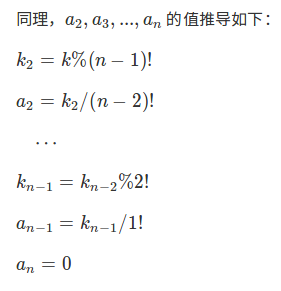
时间复杂度O(n),空间复杂度O(1)。
代码 Code
class Solution {
public:
    string getPermutation(int n, int k) {
        string s(n, '0');
        string result;
        for (int i = 0; i < n; ++i)
            s[i] += i + 1;

        return kth_permutation(s, k);
    }
private:
    int factorial(int n) {
        int result = 1;
        for (int i = 1; i < n+1; ++i)
            result *= i;
        return result;
    }

    // s 已排好序,是第一个排列
    string kth_permutation(string &s, int k) {
        const int n = s.size();
        string result;

        int base = factorial(n - 1);
        --k;  // 康托编码从0开始

        for (int i = n - 1; i > 0; k %= base, base /= i, --i) {
            auto a = next(s.begin(), k / base);
            result.push_back(*a);
            s.erase(a);
        }

        result.push_back(s[0]); // 最后一个
        return result;
    }
};